
Lost, Sought, And Finally Found
Nestor: A prominent secondary character in Homer’s Iliad and Odyssey, where he appears as an elderly warrior who frequently offers advice to the other characters. The word is used to describe a wise old man, a patriarch, or the senior, most experienced leader in a particular field.
Many of the artifacts of early baseball have been lost to time. Those that survive often find their way into private collections through auctions and sometimes through nefarious ways. For example, several rare baseball-related items have been stolen from the New York Public Library’s A.G. Spalding Baseball Collection over the years.
Sometime between fifty-six and eighty-five years ago, a proclamation presented to a baseball pioneer by a pioneering base ball club vanished from the Yale Library. The document was a beautifully crafted work of art, created by one of the most accomplished penmen of his era. With its whereabouts unknown and Yale having no record of it, it came to be feared lost, stolen, or perhaps, worse, destroyed
Overlooked 19th Century Baseball Legend
John Thorn, the official historian of Major League Baseball, referred to Doc Adams as “Baseball’s most important figure not in the Hall of Fame… More than anyone else, he created our game of nine innings, nine men, and ninety-foot basepaths.”
Daniel Lucius ‘Doc’ Adams (1814–1899) was not a peripheral figure in baseball’s early development. He was one of the most consequential actors in the game’s transition from a loosely organized recreational pastime into a more coherent, structured, and enduring sport. He is widely credited with the creation of the shortstop position.
Doc Adams was a player, club leader, rules advocate, organizer, and one of baseball’s most important early structural innovators. The Hall of Fame’s own website describes Adams as one of the figures who “helped shape baseball’s earliest days” and note that later observers referred to him as one of the “Fathers of Baseball.”
Adams arrived in New York in 1839, set-up his medical practice and began playing base ball, although it is known he was playing some form of “bat and ball” game as early as 1832.
The New York game was played by young lawyers, doctors, merchants, bank clerks and others who could leave New York twice a week at 3:30 pm. Originally formed in 1839 and called the New York Base Ball Club, “…it had no very definite organization and did not last long.” Some of the younger members of the Club got together and formed the Knickerbocker Base Ball Club, on September 23, 1845 [with by-laws, a constitution and playing rules].” …. About a month after the organization of this club, several of us medical fellows joined, myself among that number.”
Adams and the other members of the club played base ball for exercise and its health benefits. The style of game being played was closer to a “country club” activity than to a modern baseball club, the social aspect was nearly as important as the sporting aspect.
In May of 1846, his first full year with the Knickerbockers, Doc was elected Vice-President of the club and would, over his sixteen years of membership, go on to serve six terms as President (’47, ’48, ’49, ’56, ’57 and ’61) and several terms as a Director.
The first five years of the Knickerbocker’s existence were the hardest. According to Doc’s youngest child, Roger Cook Adams, in his memoir on his father written in 1939:
“Fortunately, he was a convincing speaker, and the many dinners that were held gave him his chance to keep up the enthusiasm in the early and difficult days. The term ‘pep talk’ would have meant nothing to him, but that undoubtedly was what the boys got.”
“Nestor of Ball Players”, Roger Cook Adams (1939)
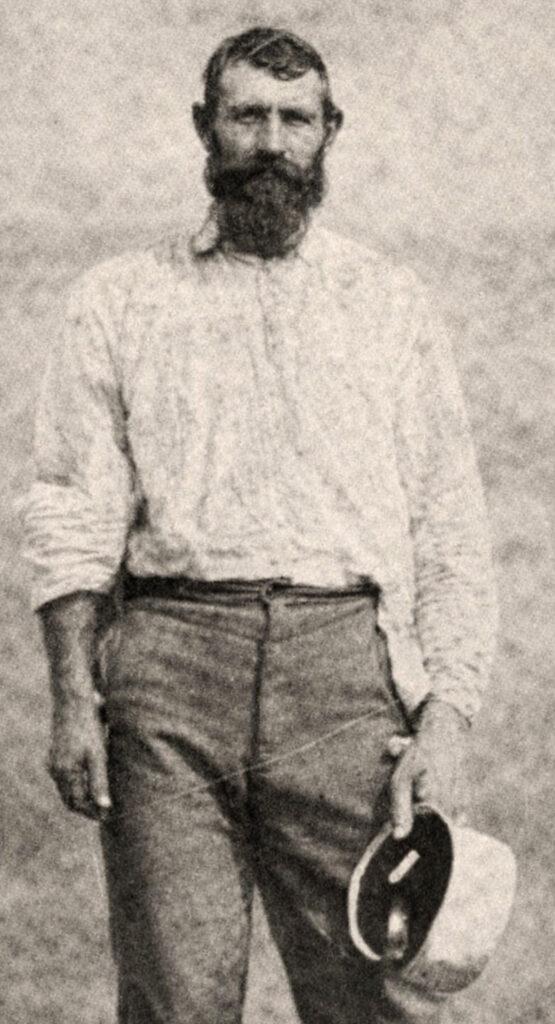
Roger Adams’s memoir of his father chronicles Doc Adams’ many contributions to baseball and is especially noteworthy for the way it highlights his father’s deep passion for the game, a passion that proved invaluable to baseball’s early development.
Adams’ love of the game led him to persevere, once saying, “As captain, I had to employ all my rhetoric to induce attendance.” Those happy hours spent at the “Elysian Fields” fueled his dedication.
When obtaining playing equipment became an early challenge, Doc stepped up and assumed responsibility for making all of the balls used by the Knickerbockers, and by other clubs as they were formed. He also ensured that bats were properly crafted and met the game’s emerging standards.
Adams was a left-handed batter and was known to take some satisfaction in hitting balls into the Hudson. His fellow teammates were less enthusiastic; however, as they were paying him to make the balls!
When the Knickerbockers revised the by-laws and rules of the club in 1848 and 1854, Adams headed the committees.
At the end of 1856, at a special Knickerbocker meeting, the club resolved to call for a convention for the purpose of standardizing rules and play. Again, by resolution, Doc and two other teammates were appointed to form a committee and call for a convention in which sixteen teams participated.
This convention was held in January and March of 1857 and Doc was elected president. Some of the significant resolutions passed at this convention were nine players per side, nine innings, ninety-foot basepaths, and the prohibition of gambling.
“In March of the next year the second convention was held [at the request of the Empire Club] and at this meeting the annual convention was declared a permanent organization, and with the requisite constitution and by-laws became the National Association of Base Ball Players [N.A.B.B.P.].”
Dr. D. L. Adams Memoirs of the Father of Base Ball – The Sporting News; February 29, 1896
Adams served as Chairman of the N.A.B.B.P. Rules and Regulations Committee from that point until he retired from the game.
It is hard to believe, but when the Knickerbocker Base Ball Club started the modern game of American baseball, the game almost died in its infancy. That it did survive was due to Dr. Daniel L. Adams. His fellow team mates dubbed him “the Nestor of Base Ball,” wise counselor, for it was his keen enthusiasm and persistent effort that kept the game alive during its first years.
“Adams of the Knickerbockers“, Robert W. Henderson, respected sports historian, New York Public Library
Retirement From The Game
On March 26, 1862, at the annual meeting of the Knickerbockers, Doc presented a letter to the club secretary, James Whyte Davis:
“I shall not be able to attend the meeting of the Club this evening and furthermore feel compelled to tender my resignation of membership. I do this with great reluctance but in accordance with a determination long since formed, never to remain an inactive non-playing member. It will be impossible for me to play during the coming season, but although absent in body, I shall be present in spirit. My interest in the Club will never cease, nor can I forget the many happy hours spent in communion with its members.”
Doc Adams resignation letter (March 26, 1862)
And so, Doc’s active participation in the game he loved, and over which he had a significant and pioneering influence, came to a close.
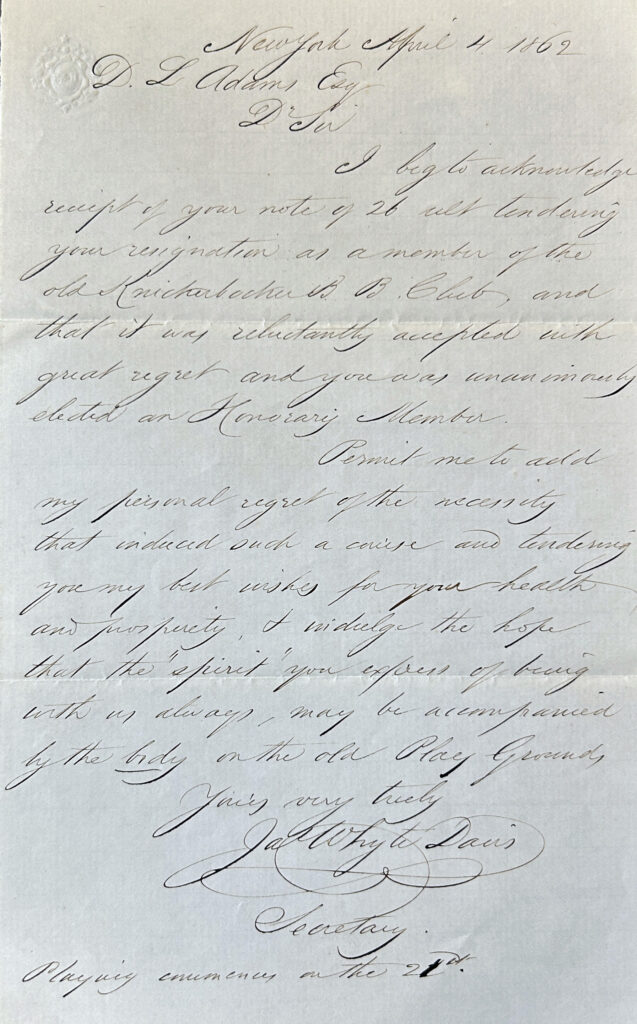
In accepting Doc’s resignation, James Whyte Davis wrote that he had been “unanimously elected an Honorary Member” and “I indulge the hope that the ‘spirit’ you express of being with us always, may be accompanied by the body on the old Play Grounds.”
I beg to acknowledge receipt of your note of 26 ult. tendering your resignation of the old Knickerbocker B. B. Club and that it was reluctantly accepted with great regret and you was unanimously elected an Honorary Member.
Permit me to add my personal regret of the necessity that induced such a course and tendering you my best wishes for your health and prosperity. I indulge the hope that the “spirit” you express of being with us always, may be accompanied by the body on the old Play Grounds.
James Whyte Davis letter to Doc Adams on the occasion of Doc’s resignation (April 4, 1862)
He closed the letter with the postscript, “Playing commences on the 21st”, as if to say, if you change your mind, please join us.
The Nestor Of Ball Players
Upon his retirement, a committee of Henry A. Thomas, Louis J. Belloni, and W. H. Tucker was appointed to draft resolutions “expressive of their feelings”.
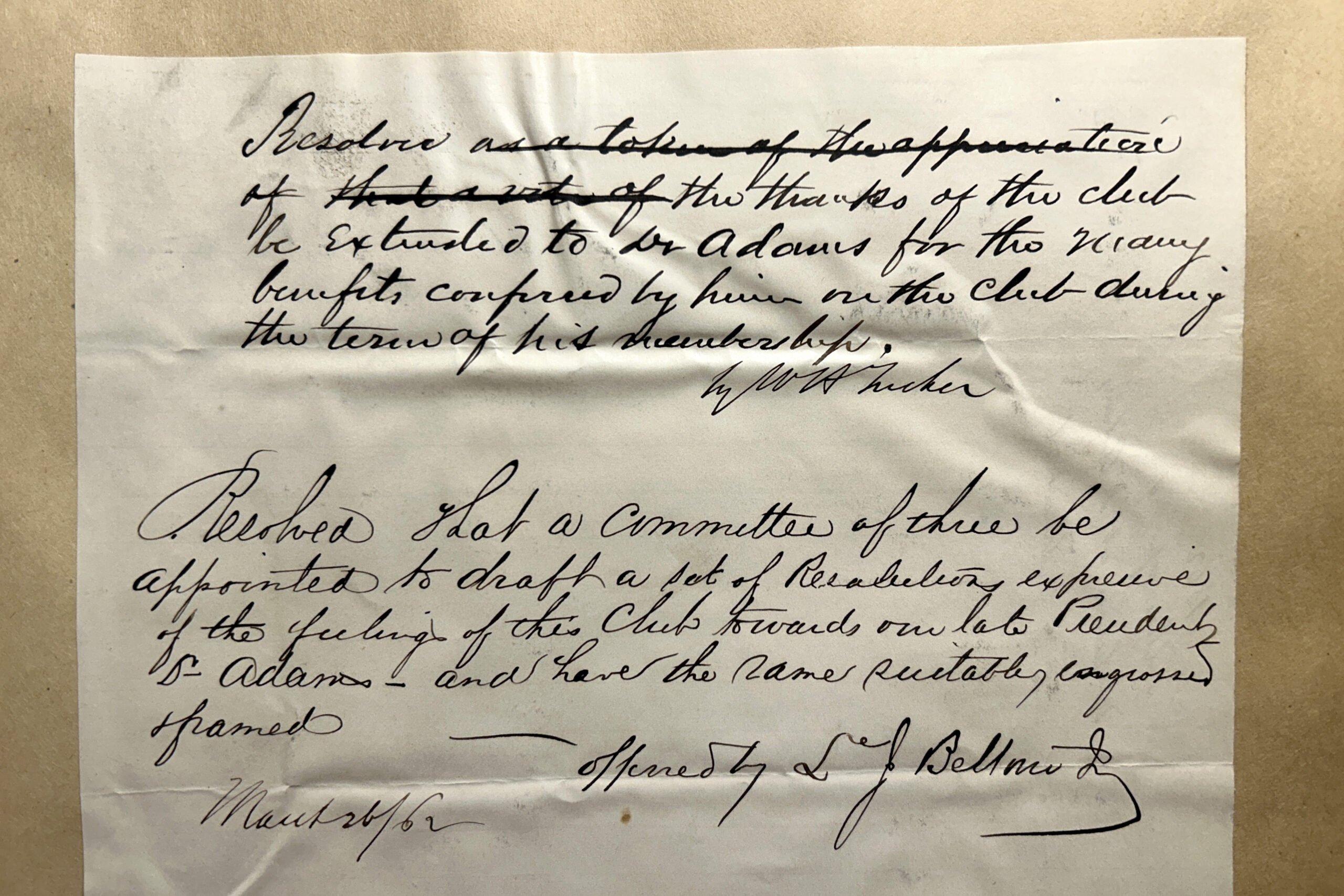
Knickerbocker Base Ball Club Correspondence 1846-1874, Spalding Collection, Manuscripts and Archives, New York Public Library
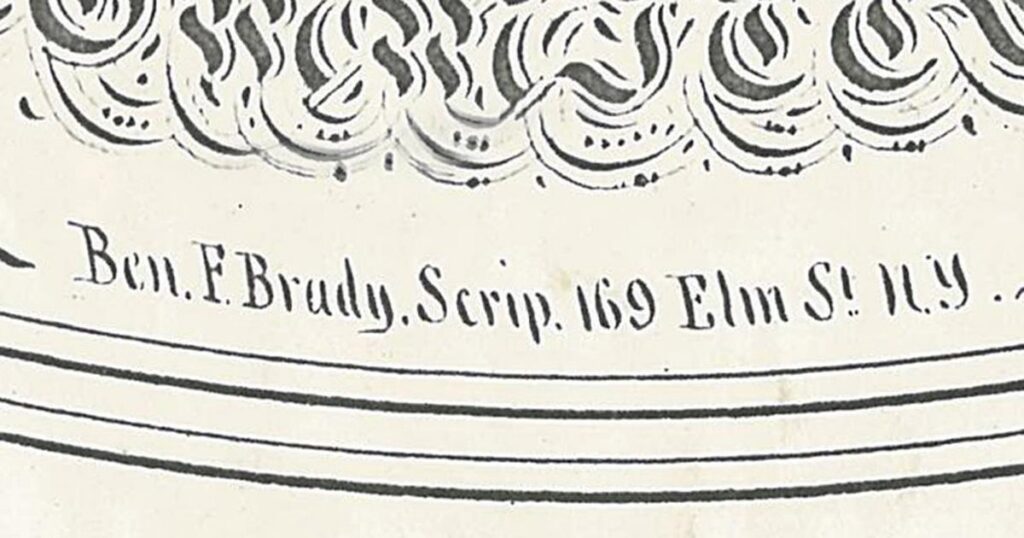
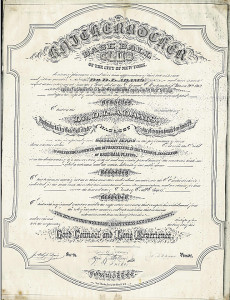
A proclamation (known as the “Nestor of Ball Players”) was produced by Benjamin Franklin Brady. The “most gorgeously engrossed” document thanking him for his “long and meritorious service to the club” was presented to Adams accompanied by a letter from the committee.
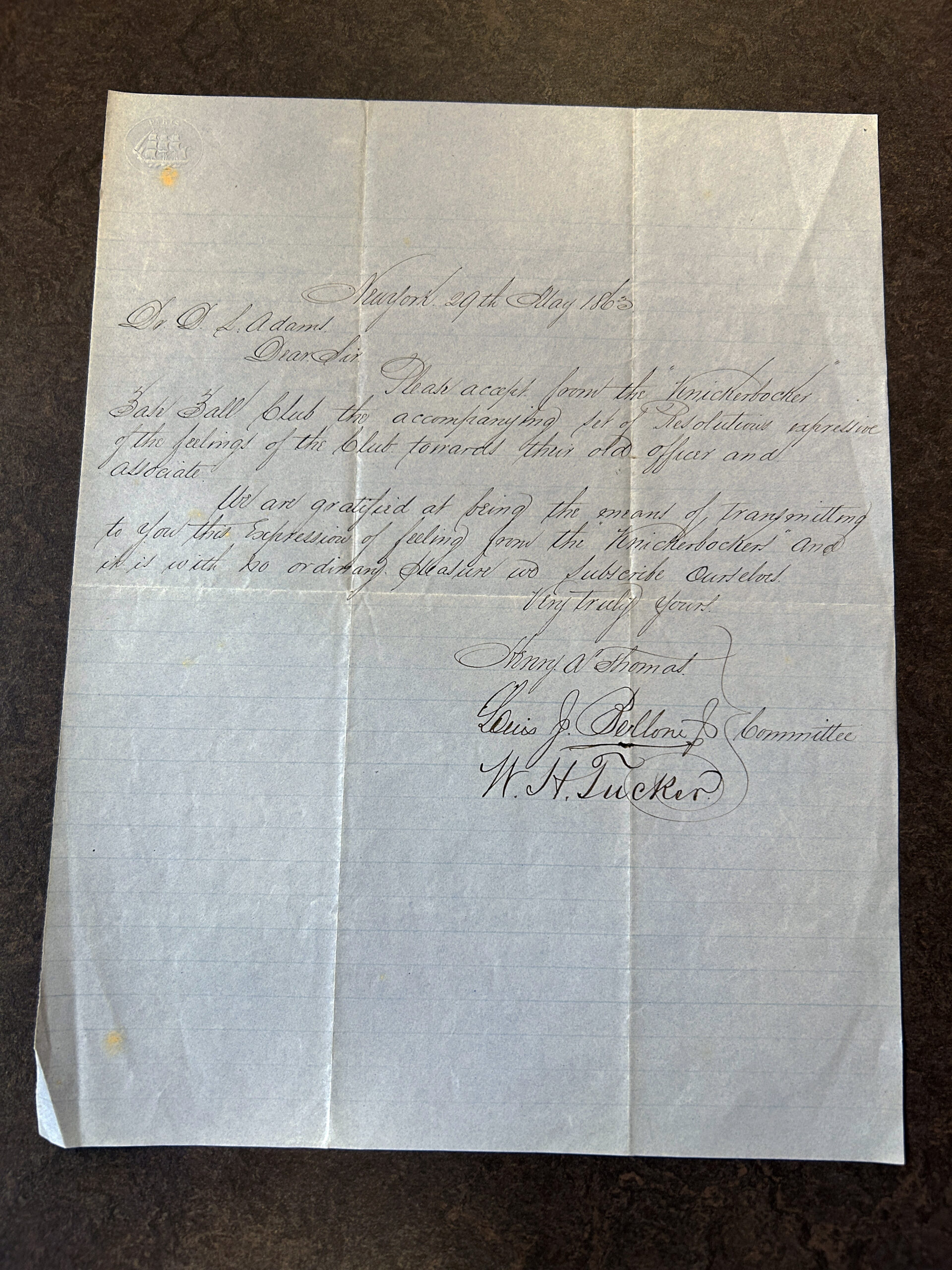
‘Please accept from the Knickerbocker Base Ball Club the accompanying set of Resolutions expressive of the feelings of the Club towards their old officer and associate.
We are gratified at being the means of transmitting to you the Expressions of feeling from the Knickerbockers and it is with no ordinary pleasure we subscribe ourselves.”
Letter from Knickerbocker Committee accompanying the “Nestor” (May 29, 1863)
The proclamation was an acknowledgement of the leadership role that he played not only with the Knickerbocker Base Ball Club but with the National Association of Base Ball Players.
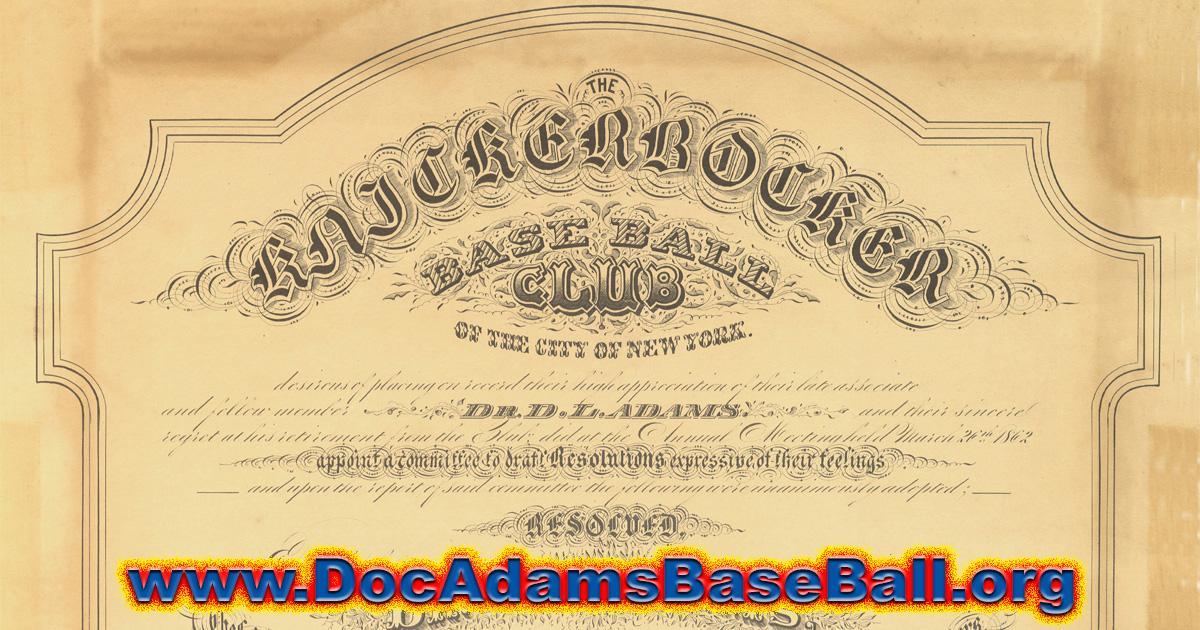
“Nestor of Ball Players” Proclamation
“The Knickerbocker Base Ball Club of the City of New York desirous of placing on record their high appreciation of their late associate and fellow member, Dr. D. L. Adams; and their sincere regret at his retirement from the club, did at the annual meeting held March 26th, 1862, appoint a committee to draft resolutions expressive of their feelings, and upon the report of said committee the following were unanimously adopted:
“Resolved, that by the resignation of Dr. D. L. Adams, the Knickerbocker Base Ball Club has lost one of its most honored members: one who for a period of sixteen years in the performance of every duty whether at the bat or in the field, as our presiding officer, or represented in the National Association of Ball Players, or in the daily walks of life, has ever been faithful and uniformly proved himself the courteous high-minded gentleman, and the zealous advocate of our noble game.
“The Knickerbocker Base Ball Club of the City of New York desirous of placing on record their high appreciation of their late associate and fellow member, Dr. D. L. Adams; and their sincere regret at his retirement from the club, did at the annual meeting held March 26th, 1862, appoint a committee to draft resolutions expressive of their feelings, and upon the report of said committee the following were unanimously adopted:
“Resolved, that to him as much if not more than any other individual member are the Knickerbockers indebted for the high rank their club has maintained since its organization, and we claim for him the honored title of “Nestor of Ball Players.”
“Resolved, that with unfeigned regret we yield to the imperative necessity that compels his withdrawal from the roll of our active members, and beg to assure him that in leaving us he carries with him our heartfelt wishes for his welfare, happiness and prosperity, and We cherish the hope often to be the recipients of the benefit of his good counsel and long experience.
James Whyte Davis, Secretary W. P. Bensel, President
Henry A. Thomas
Louis J. Belloni Committee
W. H. Tucker
The Knickerbocker Base Ball Club spent $41.00 to commission and present the proclamation to Doc Adams. Ben F. Brady was paid $25.00 for its creation, and another $16.00 was expended for its frame. In 2026 dollars, that investment would amount to roughly $1,350.00. Yet the proclamation’s true worth lies not in its monetary value, but in its enduring historical significance.


Benjamin Franklin Brady
Benjamin Franklin Brady was a well-known artist in New York City. He was recognized as an expert penman, someone highly skilled in the art of penmanship and calligraphy.
“His ability was soon recognized as he had more orders for engrossing than he could readily fill.”
“Benjamin Franklin Brady”, New York Tribune (April 1, 1888)
Counted among the most accomplished penmen of his day, he left behind a remarkable body of work. Specimens of his craftsmanship adorned public buildings throughout the region, while countless others, such as Doc Adams’ Nestor of Base Ball proclamation, were treasured by private families.
“Benjamin F. Brady… styled himself an artist penman.
His work has been famous here in New York, for many years and during his life he probably engrossed more official documents, memorials, albums and society resolutions than any other man in that line of business.”
“An Expert Penman Dead: The Work Which Benjamin F. Brady Raised To An Art”, The New York Times (April 2, 1888)
What Happened To The Proclamation?
The proclamation became a cherished family heirloom and Cornelia said in a letter that it was hung “as large as life in the dining room”.
Roger’s son, Daniel Putnam Adams, along with his wife Adelaide, recorded an interview of his father in January 1962. Roger recounted some of his recollections of what he learned about the Knickerbocker Base Ball Club from his father. He also recalled donating some of his father’s baseball artifacts to the Yale Library.
“…that that was Nestor of ball players. That was a set of resolutions passed by the club when he left it. It was a very flowery resolution… I deposited that, together with the original rule books that I had and a few letters and one thing or another with the Yale library, they have them there.”
Roger Cook Adams Interview (January 1962)
The Mystery Of The Missing Proclamation
Doc Adams’ great granddaughter, Marjorie Adams, said that the family has been trying to get Yale to locate the proclamation for years. “My grandfather donated the proclamation to Yale sometime in the 1950s and much later, sometime in the 1960s or 1970s, my father wanted to have the proclamation professionally photographed. But Yale could not locate it. We’ve been searching for it ever since.”
The disappearance traces back to at least August 1970, when Daniel Putnam Adams, Marjorie’s father, sought to acquire copies of the documents. Evidence of his effort survives in copy of a letter he sent to the Yale University Library requesting reproductions.
As Marjorie had related, the proclamation was unable to be located at that time.
She had success in obtaining copies of the letter James Whyte Davis sent to Doc upon his retirement, the famous “Topsy” letter from Henry Chadwick, and the Knickerbocker letter that accompanied the Nestor proclamation. However, it’s not clear that she ever saw the letters her great-great-grandfather wrote to his son. One thing is certain: she had no success in locating the “Nestor of Ball Players” proclamation itself.
In 2011, a formal request was submitted to Yale seeking access to the proclamation. The response from a Yale archivist was discouraging: “Unfortunately, I have not found any reference to the proclamation that was presented to Daniel L. Adams upon his retirement from baseball in 1862.”
Yale still held the letter that had accompanied the proclamation, but the proclamation itself was missing from the collection and there was no record of it.
The library’s Head of Collection Development was subsequently contacted to inquire about what efforts were being made to locate the missing document and whether official accession records from the original Adams donation still existed. His response was brief: he was “unable to comment.”
A Serendipitous Coincidence
Fast forward to May 2026. Hayden Trubitt, the current owner of the “Laws of Base Ball” documents, arranged for their long-term display at the National Baseball Hall of Fame. The Hall incorporated the documents into its “Taking the Field” exhibit and scheduled the debut to coincide with the opening of its Military Classic Weekend, part of the institution’s Memorial Day observance and America 250 commemoration.
Nate Adams Downey, Doc Adams’ great-great-grandson, stopped in Connecticut the week before Memorial Day before traveling to Cooperstown for the debut. During his trip, he visited a number of sites in New York, New Jersey, and Connecticut associated with his distinguished ancestor.
While in Connecticut, I gave Nate a tour of New Haven, including the burial sites of Doc and his wife, Cornelia, as well as the two homes where they once resided. We also visited Yale’s Beinecke Rare Book and Manuscript Library. Although we did not have time to conduct any research during the visit, the stop ultimately proved worthwhile.
While speaking with a member of the library’s security staff, we learned that the library had recently updated and digitized its catalog.
After returning from Cooperstown, I conducted a search and was rewarded with three promising hits:
- Adams, Daniel 14 ALS [Autographed, Letter, Signed] to his son, Daniel Lucius Adams
- Adams, Daniel Lucius 1833-1898
- Adams, Daniel Lucius 1862
The third listing particularly piqued my interest, though I tried not to get my hopes up (even though the folder was called “Miscellaneous Manuscripts: Oversize”).
I requested a hold on the three items (two were in offsite storage) and a few days later I was enroute to the Yale’s Sterling Memorial Library to review the papers.
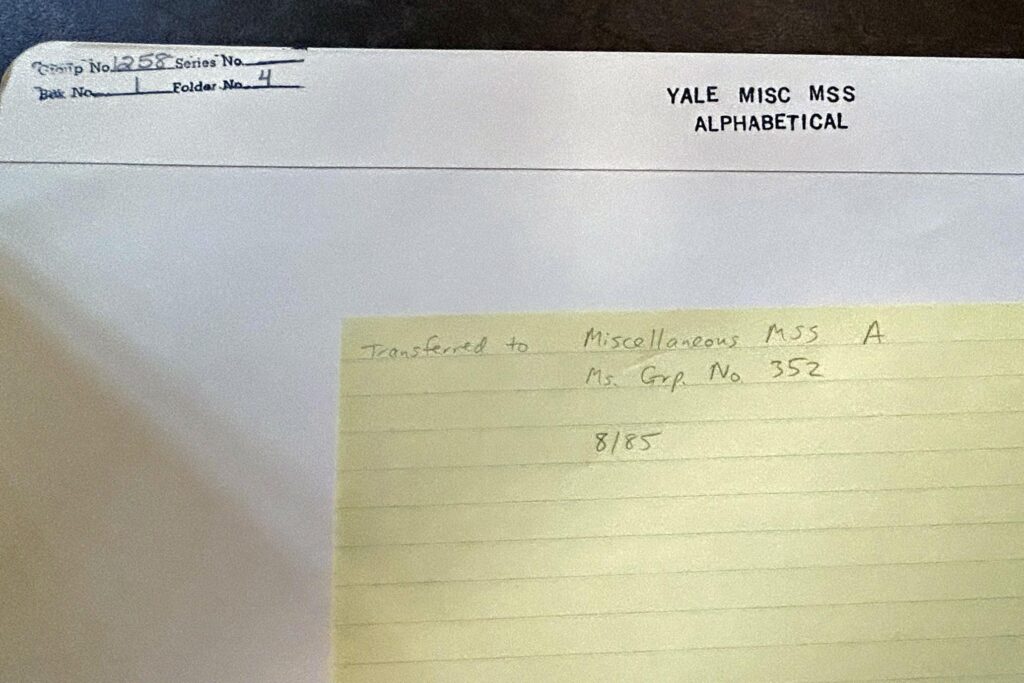
After receiving a brief tutorial on how to handle the documents, the staff brought me the first box. However, I was immediately disappointed when I opened it. I pulled out the specified folder and found it contained a solitary note stating “Transferred to Miscellaneous MSS A, Ms. Grp. 352, 8/85”. The staff, however, couldn’t decipher the note and identify where the contents had been moved. So, I abandoned that box and exchanged it for the second one.
To our surprise, the letters from Daniel Adams to Doc had actually been transferred to this second box.
The folder in that box contained fourteen original letters along with typed transcriptions.
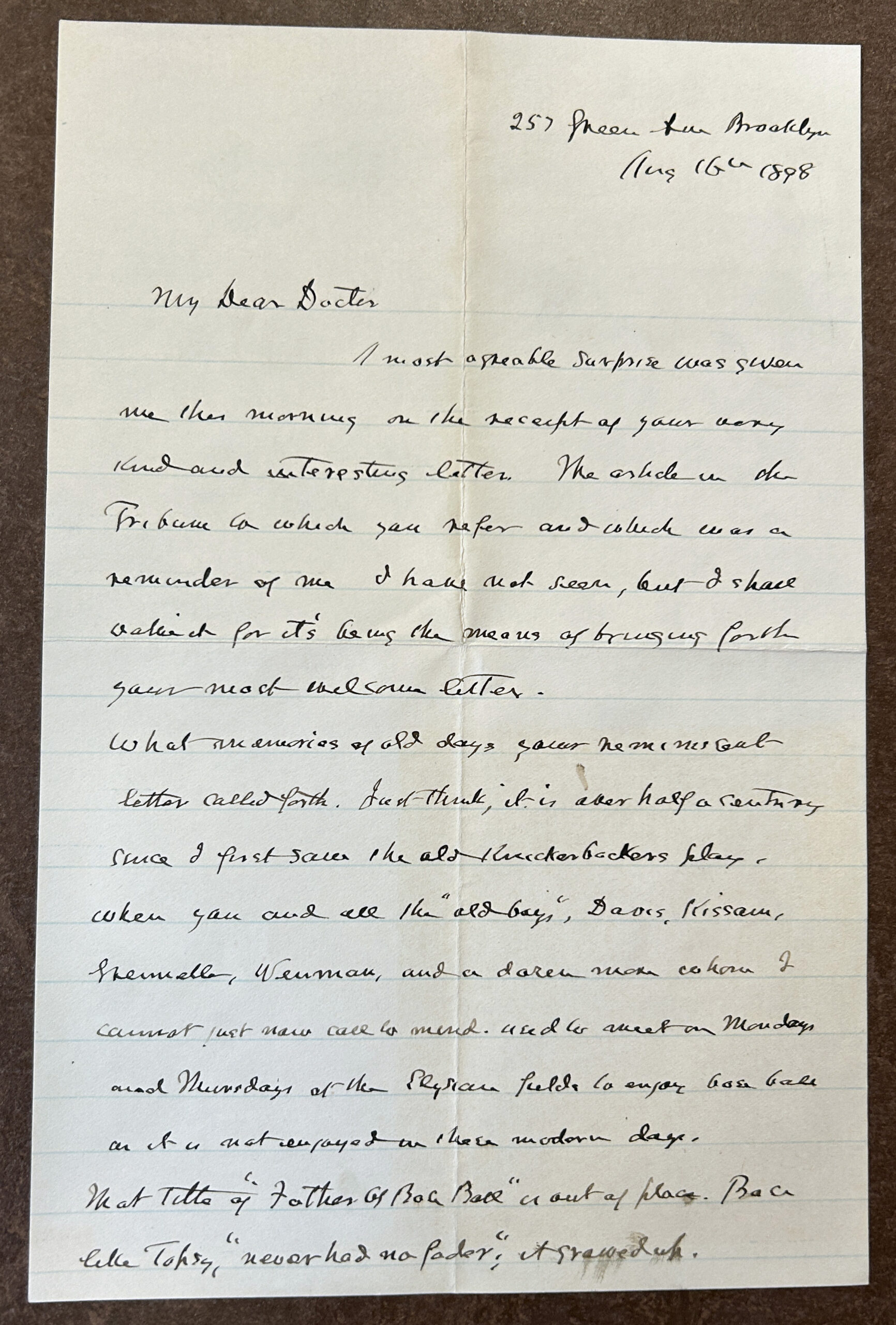
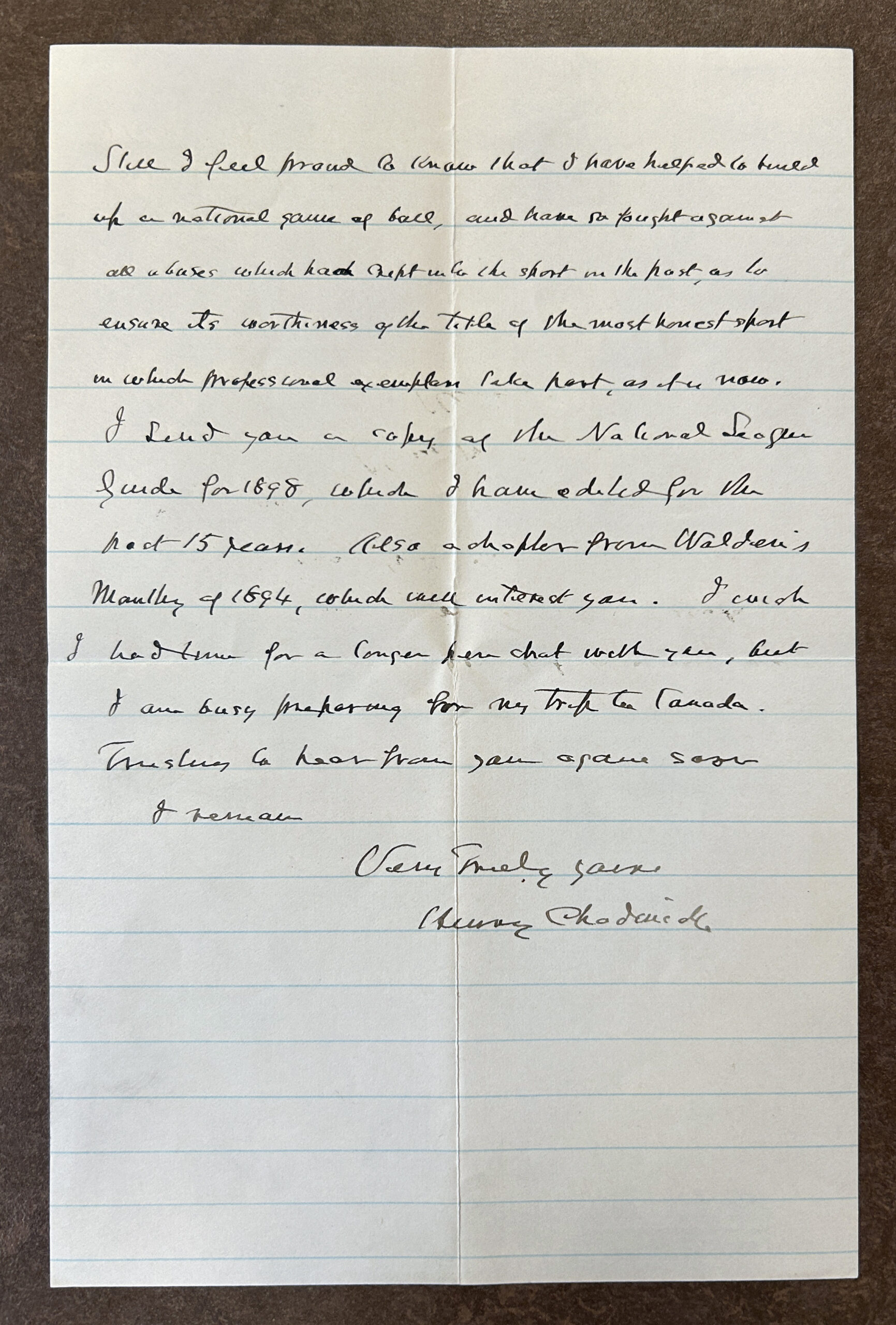
It also included the letter James Whyte Davis sent to Doc upon his retirement, as well as the famous “Topsy” letter Henry Chadwick wrote to Doc.
“Base [ball], like Topsy, ‘never had no fader’; it growed up.”
Letter From The Knickerbockers Accompanying The “Nestor of Base Ball” Proclamation, Manuscripts and Archives, Yale University Library
The final item in the folder was the letter that accompanied the “Nestor of Ball Players” proclamation from the Knickerbocker committee that drafted the resolutions: Henry A. Thomas, Louis J. Belloni, and William H. Tucker.
These documents were first discovered by John Thorn in the mid-2000’s.
Although Yale had denied ever having received the proclamation, the Knickerbockers’ letter rekindled my hopes, even though experience should have taught me better.
At Last, The Search Ends
When I finished reviewing the contents of the second folder, I exchanged the box for the third item, a large, oversized folder. The proclamation had been missing for at least fifty-six years and numerous efforts to locate it had failed, So while I opened the folder with anticipation, I did so with little real expectation of finding anything.
To my amazement, when I opened the folder I saw the word “Knickerbockers” peeking out between several documents. I realized that I was looking at the top of the “Nestor of Ball Players” proclamation!
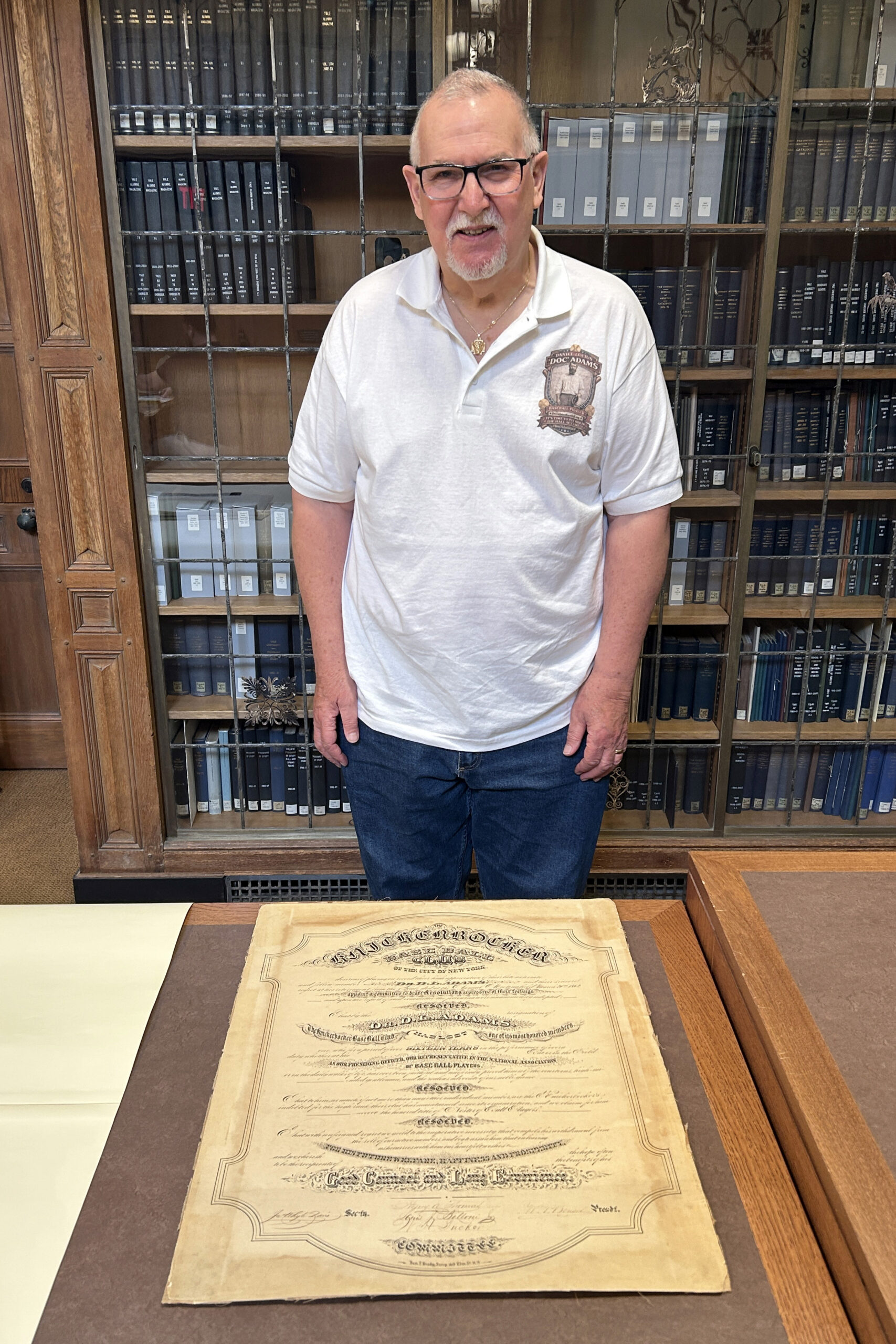
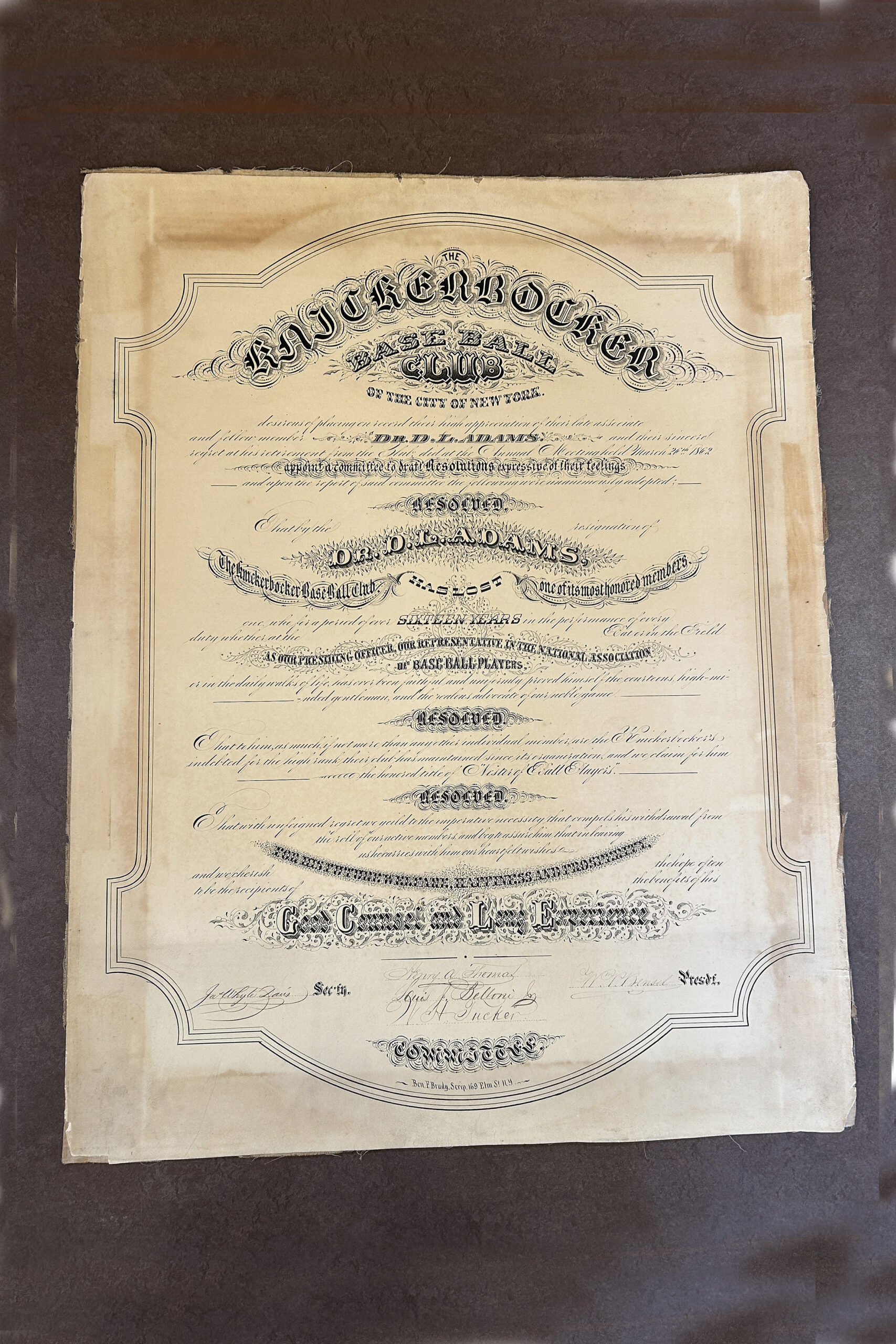

I sat there for a while, absorbing the moment. It was hard to believe that this 164-year-old document was finally in front of me. I had known its story for more than fifteen years and understood that it had been sought unsuccessfully for at least fifty-six years. Holding it in my hands, I appreciated the significance of what had survived, even if neither the document nor the man it celebrated is widely known or properly acknowledged today.
I couldn’t wait to share news of the find with Nate, so I immediately texted him a photo with no description. Needless to say, he was very excited and looks forward to seeing it in person the next time he visits the area.
I’m just sorry Marjorie and Nancy Adams Downey never got to see it.
Completing The ‘Roger C. Adams’ Collection
Upon returning home, I relistened to Roger C. Adams’ interview and was reminded that he mentioned that he donated “the original rule books that I had” to Yale as well. Armed with that information, I conducted a follow-up search, which produced the following:
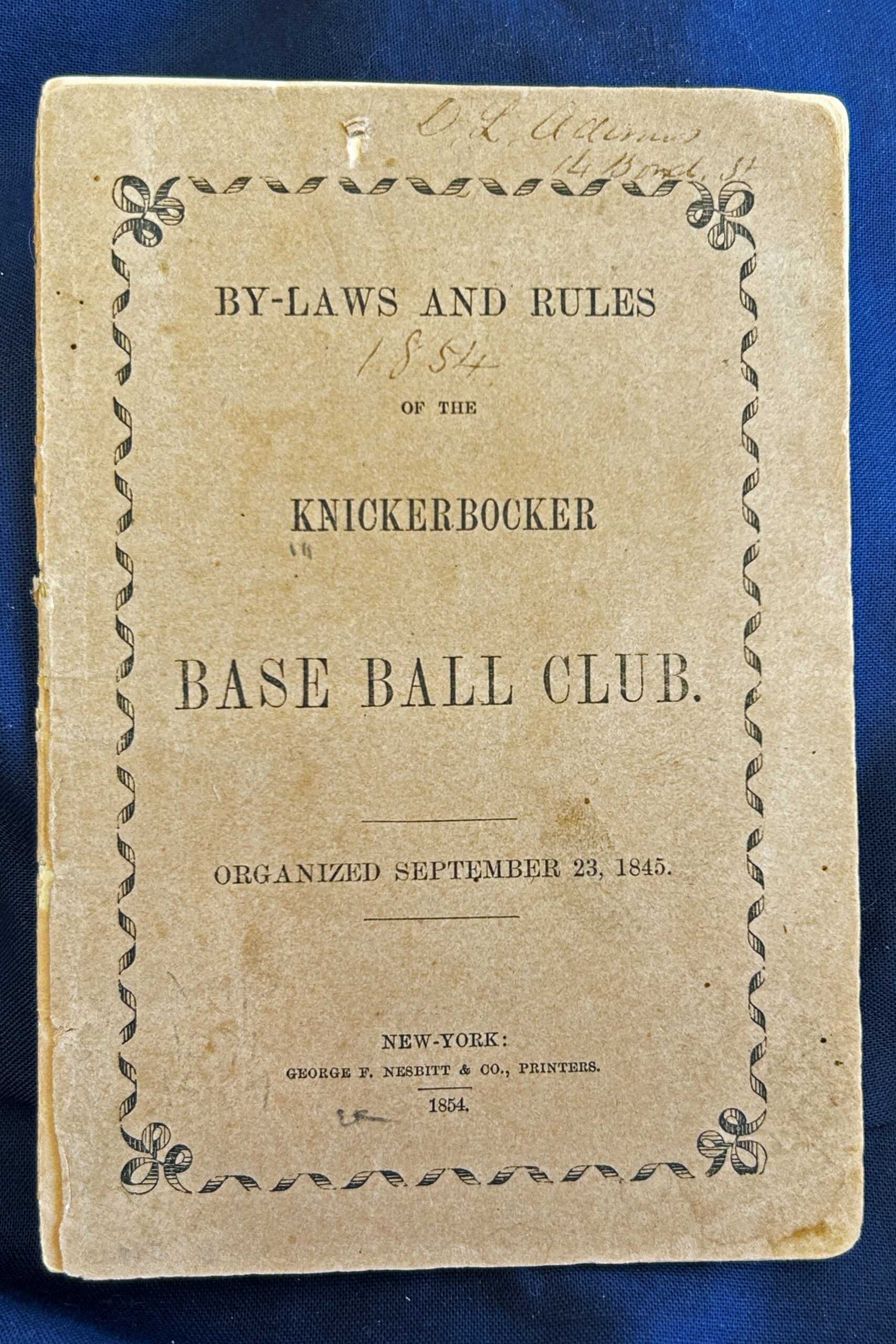
- By-Laws and Rules of the Knickerbocker Base Ball Club: Organized September 23, 1845 (April 1848)
- By-Laws and Rules of the Knickerbocker Base Ball Club: Organized September 23, 1845 (April 1854)
- By-Laws and Rules of the Knickerbocker Base Ball Club: Organized September 23, 1845 (April 1857)
Examining these pamphlets which had not been missing was a bit anti-climactic after finding the proclamation, but it was exciting, nonetheless.
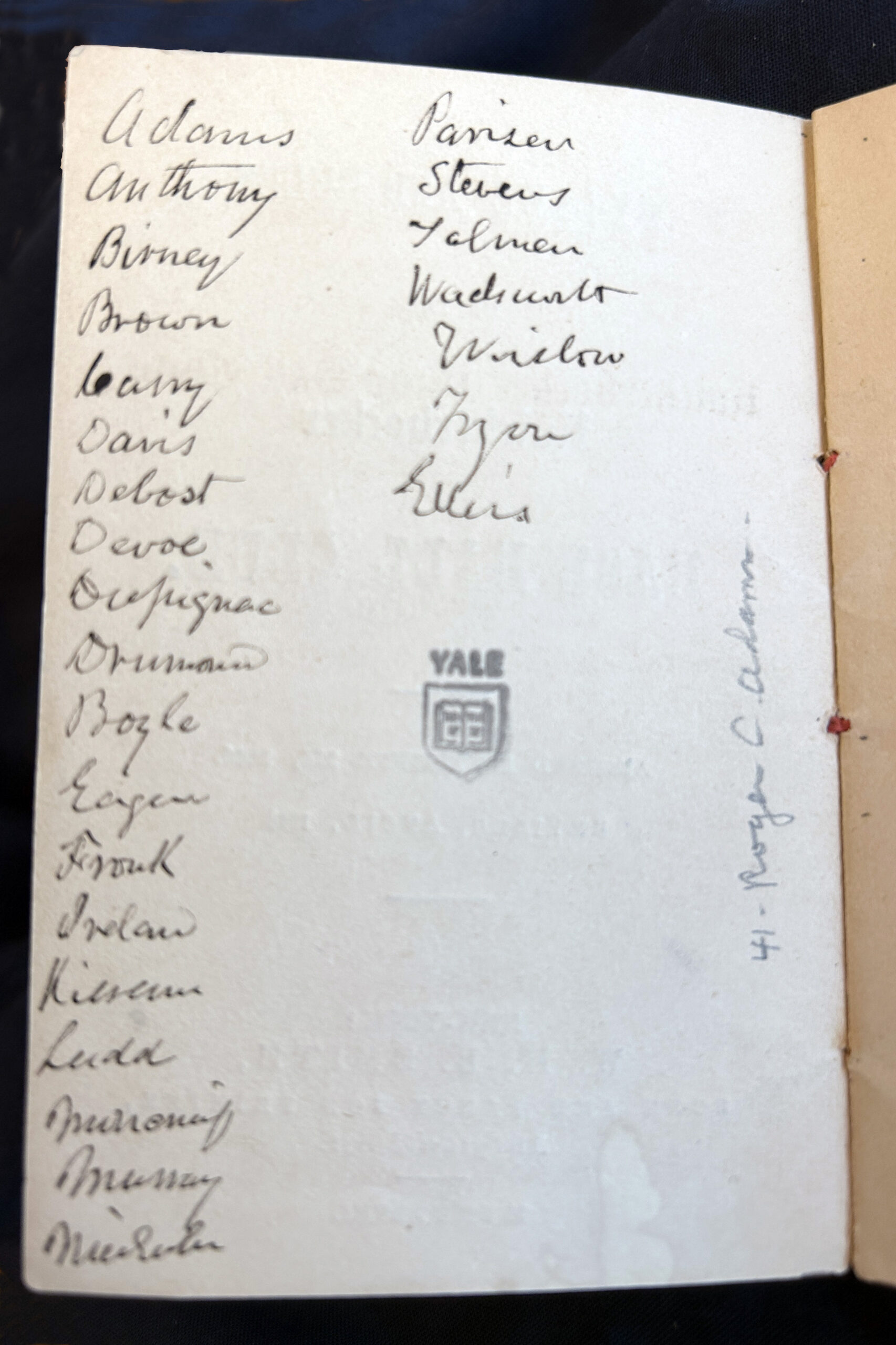
Each of the volumes is inscribed with “41- Roger C. Adams” which may indicate the year they were donated to the library, 1941.
The 1848 document had a handwritten list of 26 members of the team on the inner cover.
Even better, Doc Adams signed the front cover of the 1854 document, “D. L. Adams, 14 Bond St.” Interestingly, Daniel L. Adams does not show up at “14 Bond St” in a New York City directory until 1859 and is incorrectly identified as a dentist. In the 1860 edition, he is correctly described as a physician.
Although finding the proclamation was nothing short of magical, holding Doc Adams’ personal copies of the Knickerbocker Rules came in a very close second, offering another rare and direct connection to baseball’s formative years and one of baseball’s earliest pioneers.
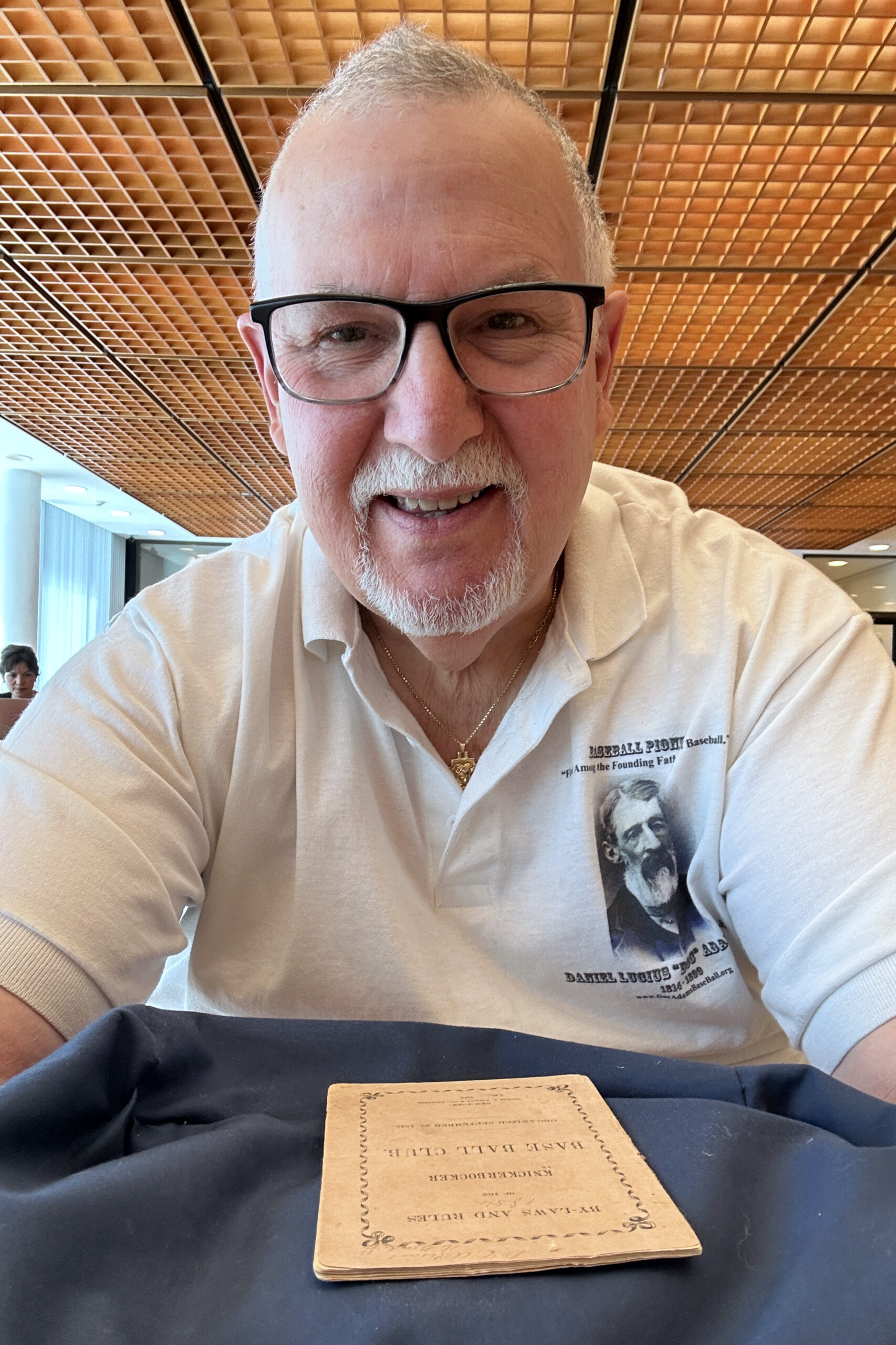
There’s still work to do to understand how the proclamation went missing for somewhere between fifty-six to eighty-five years and how it fortunately resurfaced. But for the moment, we’ll just celebrate that it’s been found.
Discover more from Doc Adams Base Ball (Official)
Subscribe to get the latest posts sent to your email.
Cranky is flipping over in her grave!!
Thank you for your perseverance!
So glad we now have it!!
Hopefully this will add to all the overwhelming evidence that Doc belongs in the Hall of Fame—Cranky’s goal from day one!! My prayers are for that day to come soon!
Thanks Cindy! I’m sure she would have been thrilled! Hopefully, one day soon, the Hall of Fame will admit what we already know! Thanks for your continued interest and support!
Congrats, Roger, on some exceptional digging!