
Doc Adams Belongs In Cooperstown
Baseball cannot tell the truth about its origins while one of its most important pioneers remains outside the National Baseball Hall of Fame.
Why This Awareness Campaign Exists
This is not just about one overlooked pioneer
It is about whether baseball is willing to correct its own history.
For generations, baseball’s public memory has centered on a simplified origin story that elevated some figures while obscuring others. Meanwhile, Daniel Lucius “Doc” Adams — one of the most important structural architects of the early game — remains outside Cooperstown despite a historical record that increasingly places him at the center of baseball’s formative development.
This is not merely an omission. It is a historical imbalance — and one the Hall of Fame has the power to correct.
Doc Adams is not outside Cooperstown because his case is weak. He is outside because baseball’s institutional memory has been slow to catch up with its own historical record.
The Man Behind the Case
Who Was Doc Adams?
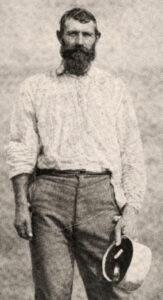
Daniel Lucius “Doc” Adams (1814–1899) was not simply an early baseball player. He was one of the men who helped transform baseball from a loosely organized pastime into a recognizable and enduring sport.
John Thorn, the official historian of Major League Baseball, referred to Doc Adams as “Baseball’s most important figure not in the Hall of Fame… More than anyone else, he created our game of nine innings, nine men, and ninety-foot basepaths.”
Adams was a player, club leader, rules advocate, organizer, and one of baseball’s most important early structural innovators. The Hall of Fame’s own historical materials describe Adams as one of the figures who “helped shape baseball’s earliest days” and note that later observers referred to him as one of the “Fathers of Baseball.”
Adams’ love of the game led him to persevere, once saying, “As captain, I had to employ all my rhetoric to induce attendance.” Those happy hours spent at the “Elysian Fields” fueled his dedication.
One of the oddest features of the Doc Adams debate is that his Hall of Fame status and his historical importance are profoundly out of alignment.
The Historical Record
What Did Doc Adams Do?
Doc Adams’ contributions were not peripheral — they were foundational.
Led Early Rules & Governance
As a leader of the pioneering and influential Knickerbocker Base Ball Club, presiding officer of the first baseball convention, and one of the game’s earliest rules authorities, Adams helped give structure to baseball at the critical moment it was evolving from a casual pastime into an organized sport.
Helped Establish 90-Foot Base Paths
Adams later recalled that he fixed the distance between bases at 30 yards (vs. 42 paces or 74.25 feet) — the 90-foot geometry that still defines baseball.
Helped Standardize 9 Players & 9 Innings
During the critical rules era of the 1850s, Adams played a central role in helping standardize the structure of modern baseball. The winner was no longer decided by being the first club to score 21 runs (“aces”), but instead by the club leading after nine innings and the number of players on a team were fixed at nine.
Created the Shortstop Position
Adams is widely credited with creating the role that became shortstop — a defining defensive position still central to the game today.
His Love of the Game Kept Early Base Ball Alive
Adams had to employ all his “rhetoric to induce attendance, and often thought it useless to continue the effort, but my love of the game, and the happy hours spent at the ‘Elysian Fields’ led me to persevere”. For six or seven years he made all the balls himself, not only for his club but also for other clubs when they were organized while personally supervised the turning of the bats.
Doc Adams did not simply play early baseball. He helped shape what baseball would become.
Chronology
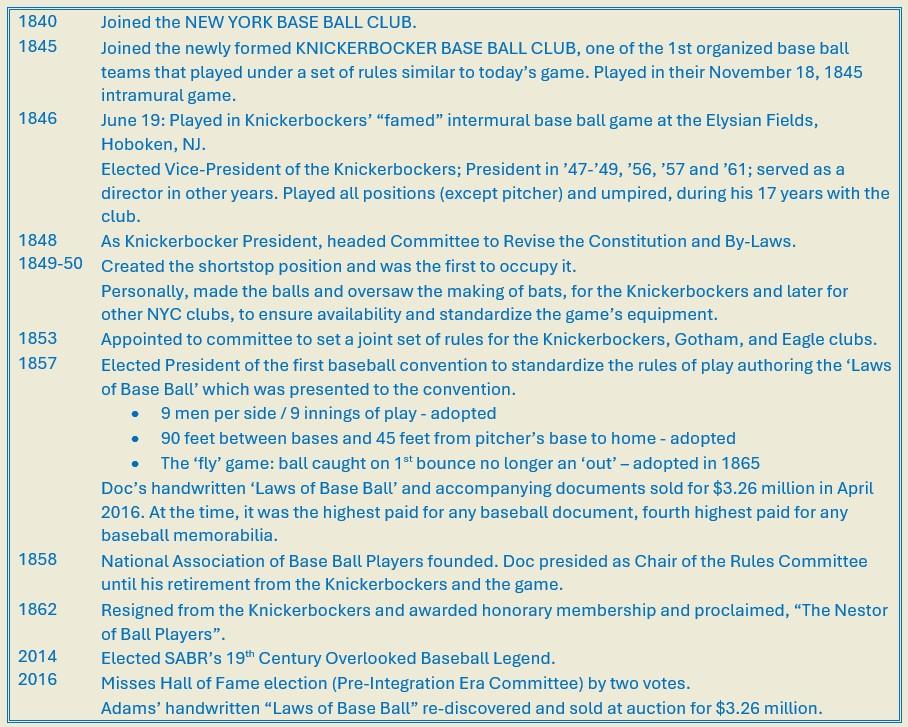
Doc’s Baseball Timeline
Doc Adams’ case is strongest when viewed not as a single claim, but as a sustained record of influence across baseball’s formative years as is also detailed in his biography..
The Attribution Problem
The Hall of Fame’s Cartwright Problem
For more than a century, baseball has struggled to tell the truth about its own beginnings.
The game has always preferred a clean founding story: one inventor, one origin point, one heroic architect who can be memorialized and explained in a few lines of bronze. But baseball’s actual early history is not neat, and it never was. It is collaborative, contested, incremental, and full of men whose contributions were absorbed into the game long before they were properly recognized.
No figure better exposes that problem than Daniel Lucius “Doc” Adams.
Adams remains outside the National Baseball Hall of Fame, despite a historical record that places him among the most consequential figures in baseball’s formative development. He is widely credited with creating the shortstop position, helping establish 90-foot base paths, playing a leading role in the adoption of nine-player teams and nine-inning games, and shaping the early rules and organization of baseball at precisely the moment when the sport was becoming something recognizable and durable.
And yet Adams is still not in Cooperstown.
That is not simply an omission. It is the result of a larger institutional failure — one that has allowed an older and weaker version of baseball history to remain more powerful than the evidence that has since corrected it.
At the center of that failure is Alexander Cartwright.
That story made sense in a certain kind of American mythology. After the collapse of the absurd Abner Doubleday invention legend, baseball still wanted a founder — someone respectable, plausible, and easy to commemorate. Cartwright fit the role. He was elevated into Cooperstown in 1938 and came to occupy the place once reserved for myth: the man who supposedly brought order to the game.
For decades, baseball elevated Alexander Cartwright as the central founding figure of the modern game. But historians — including MLB official historian John Thorn — have challenged several of the specific innovations long associated with Cartwright, including 90-foot base paths, nine players per side, and nine-inning games.
These are exactly the kinds of contributions more closely associated with Doc Adams and the 1857–58 rules standardization era. That is why this issue is bigger than one man’s Hall of Fame candidacy. It is about whether baseball’s most powerful historical institution is still preserving outdated attribution.
|
Long Associated with Cartwright |
More Strongly Linked to Doc Adams |
|---|---|
|
90-foot base paths |
Helping establish 90 feet between bases |
|
Nine players per side |
Helping standardize nine-man teams |
|
Nine-inning games |
Helping standardize nine-inning games |
|
Foundational field structure |
Creating the shortstop position |
|
“Father of modern baseball” mythology |
Structural leadership in baseball’s early codification |
Alexander Cartwright founded the Knickerbocker Base Ball Club in 1845. Doc Adams joined the team shortly after its inception and by 1846 was elected its President for the first of his six terms.
The rules did not change drastically until the first baseball convention in 1857. Doc Adams was elected President of the convention and for the remainder of his career, he served as Chairman of the Rules and Regulations Committee for the National Association of Base Ball Players.
The three rules that Cartwright was credited with as the “Father of Modern Base Ball” were not implemented until that convention of 1857, eight years after he headed west, leaving the Knickerbockers to join the California Gold Rush in 1849.
Doc Adams handwritten draft, the “Laws of Base Ball” were presented at that convention marked the true beginning of modern baseball. Besides the three fundamental rules incorrectly attributed to Cartwright on his Hall of Fame plaque, another fundamental rule that appeared for the first time in the 1857 “Laws of Base Ball” was the prohibition of gambling.
|
Cartwright Rules |
Notes |
1857 Laws of Base Ball |
|---|---|---|
|
4. The bases shall be from “home” to second base, forty-two paces; from first to third base, forty-two paces, equidistant. |
1854: Added “and from Home to pitcher not less than 15 paces”.
Maybe the confusion comes from the 13th century Welsh pace which was reckoned as 3 Welsh feet. The problem is that a Welsh foot was 9 inches so this would result in an even be shorter distance – 66.8 feet). |
Section 3. The bases must be four in number, placed at equal distances from each other, and securely fastened upon the four corners of a square whose sides are respectively thirty yards. They must be so constructed as to be distinctly seen by the umpires and referee, and must cover a space equal to one square foot of surface; the first, second and third bases shall be canvas bags, painted white, and filled with sand or saw-dust; the home base and pitcher’s point to be each marked by a flat circular iron plate, painted or enameled white. |
|
8. The game to consist of twenty-one counts, or aces; but at the conclusion an equal number of hands must be played. |
The term ace appears to have come from the older, general English meaning of “one point” or “a winning mark,” much like an ace in cards or dice. |
Section 26. The game shall consist of nine innings to each side, when, should the number of runs be equal, the innings shall be continued until a majority of runs, upon an equal number of innings, shall be declared, which shall conclude the game. |
|
No rule. |
There was not yet a fixed official number of players on a baseball team. Knickerbocker style of base ball, teams often played with 7, 8, 9, 10, or even 11 men, depending on who showed up. In practice, 8 men per side was common in the early 1840s. Recent research indicates that 9 players became common practice for match games in the mid-1850s. |
Section 27. In playing all matches, nine players from each club shall constitute a full field, and they must have been regular members of the club which they represent, for thirty days prior to the match. No change or substitution shall be made after the game has been commenced, unless for reason of illness or injury. Positions of players shall be determined by captains, previously appointed for that purpose by the respective clubs. |
|
No rule. |
First appearance of a rule against gambling. |
Section 30. No person engaged in a match, either as umpire, referee, or player, shall be either directly or indirectly interested in any bet upon the game. Neither umpire, referee nor player shall be changed during a match, unless with the consent of both parties, except for a violation of this law, and except as provided in section 27, and then the referee may dismiss any transgressor. |
We shouldn’t become overly fixated on any single rule in isolation. Much of that focus likely stems from the National Baseball Hall of Fame and Museum defining the “modern game” through the familiar framework — nine innings, nine players, and 90-foot basepaths — long associated with Alexander Cartwright’s plaque.
At the same time, there is broad historical consensus that the 1857 Base Ball Convention marked a true turning point — the moment when baseball began to take the form we recognize today.
But Adams’ story is about more than just rules. As there was no single “Father of Baseball” – leadership and innovation was fundamental to evolve a game to a sport.
This is the uncomfortable truth at the center of the matter: Cartwright entered the Hall of Fame during an era when baseball preferred clean legends, while Adams has sought entry in an era that knows more history but offers fewer opportunities to correct old mistakes.
The Voting Bottleneck
The Hall of Fame Process Failed Adams
Despite the strength of his historical case, Doc Adams has appeared on a Hall of Fame ballot only once.
In the 2016 Pre-Integration Era Committee election, Adams received 10 of 16 votes, missing induction by just two votes. No one was elected that year.
That result should have been treated as a sign that Adams’ candidacy was not marginal — it was on the doorstep. Instead, the Hall’s committee structure allowed that momentum to disappear into silence. That despite the re-discovery of his groundbreaking “Laws of Base Ball” that served as the foundation of the modern game.
But the Hall’s Era Committee structure for early baseball figures is so narrow and so infrequent that even a near-election can become functionally meaningless. Unlike modern players, who receive years of annual debate and repeated ballot visibility, 19th-century pioneers are often dependent on:
- an era that spans approximately 170 years,
- a small screening group to place them on the ballot (with limited 19th century historical expertise),
- a reduced number of candidates on the ballot (from 10 to 8),
- a 16-person electorate to consider them,
- reduced number of candidates each member of the electorate can vote for (from 4 to 3),
- and long stretches of silence between opportunities.
That is not a robust correction system.
This is one of the biggest structural problems in Hall of Fame voting for early baseball pioneers: limited ballot spots, tiny electorates, infrequent voting opportunities, and little public accountability.
Doc Adams did not fail the Hall of Fame process. The Hall of Fame process thus far, has failed Doc Adams.
Coverage & Resources
Media & Press
This section collects some key published articles, podcasts, and videos related to Doc Adams and his Hall of Fame case. The site maintains a more comprehensive list of articles and posts, podcasts, and publications.
Featured Biography
Doc Adams (SABR)
The Baseball Biography Project is an ongoing effort to research and write comprehensive biographical articles on people who played or managed in the major leagues or otherwise made a significant contribution to the sport. The project is run by SABR’s Bio Project Committee. Adams’ biography was written by the Official MLB Historian, John Thorn.
Featured Article
Doc Adams helped shape baseball’s earliest days
This was the full biography prepared by Bill Francis of the National Baseball Hall of Fame when Doc Adams was named to the 2016 Pre-integration ballot in 2016.
Featured Article
5 Inventors
In his FIVES series, John Thorn offered “up five inventors in five categories… with four runners-up in each”. The leadoff category was “The Game Itself” and his obvious choice was Doc Adams.
Featured Article
The Laws of Baseball … and the “Unchanging Game”
The groundbreaking “Laws of Base Ball” were displayed at the Library of Congress in 2018 as part of their “Baseball Americana” exhibit. This was the second time the “Laws” were displayed to the public. This is the speech John Thorn delivered at its opening July 14, 2018.
Featured Video
Introducing Doc Adams
This is a video presentation that provides a full biography of Doc’s life, from his early years in Mont Vernon, through his base ball years, and his retirement years. The primary focus is his base ball playing days and his contributions to the development of our national pastime during its nascent period.
Featured Post
Dr. D. L. Adams: Memoirs of the Father of Base Ball
This interview of Doc Adams was published in The Sporting News on February 29, 1896. Adams recalls his base ball days and provides insight into the early game’s development. A similar earlier interview was found in the Chicago Chronicle dated June 23, 1895.
Featured Post
Jay Jaffe of FanGraphs Weighs In On The Classic Baseball Era Ballot
Jay Jaffe of FanGraphs, who has been a consistent supporter of Doc Adams Hall of Fame candidacy, weighed in on Doc Adams once again being left off the Hall of Fame ballot.
Featured Report
Analysis of the “Laws of Base Ball”
This analysis of the “Laws of Base Ball” and its historical significance is contained in the Base Ball: A Journal of the Early Game Volume 9. It can be accessed via a free account on Archive.org.
Help Correct the Record
It’s not just about the rules. It’s not just about creating the shortstop position.
Daniel Lucius ‘Doc’ Adams was pioneer on and off the field during baseball’s nascent period.
His commitment to the game helped sustain the influential Knickerbocker Base Ball Club at a time when participation was inconsistent and enthusiasm was far from guaranteed. When clubs struggled to obtain equipment, Adams stepped in — personally crafting baseballs not only for his own club, but for others as well. He even oversaw the production of bats. These aren’t anecdotes — they are documented facts.
His leadership was recognized by his peers as he was elected by his teammates as team president. In 1857, he was elected president of the first baseball convention which marked the birth of the modern game. Finally, he served as the chairman of the Rules and Regulations committee of the National Association of Base Ball Players from its inception until he retired from the game.
Upon his retirement, the Knickerbocker B.B.C. proclaimed him as the “Nestor of Ball Players” which means “one who is a patriarch or leader in a field”.
He was also one of the individuals who has been referred to as a “Father of Baseball”.
His contributions are clear and well documented.
His contemporaries clearly held him in high regard — and today’s respected historians and writers continue to affirm that legacy.
The case for Doc Adams is not waiting for discovery. It is waiting for action.
You can help by:
- Raising awareness.
- Speaking his name.
- Writing his story.
- Spreading his legacy.
- Sharing this page.
- Pushing for his recognition.
Help build the public pressure needed to bring Doc Adams to Cooperstown.
Doc Adams isn’t just a historical footnote; he’s woven into the fabric of baseball’s DNA. His legacy lives on in every pitch, every stolen base, and every double play turned.
Share This Page
The Hall of Fame does not need new evidence to honor Doc Adams. It just needs the institutional courage to act on the evidence it already has.
Daniel Lucius “Doc” Adams
Baseball Pioneer
#DocAdamsHOF