Thoughts About The ‘Laws Of Base Ball’
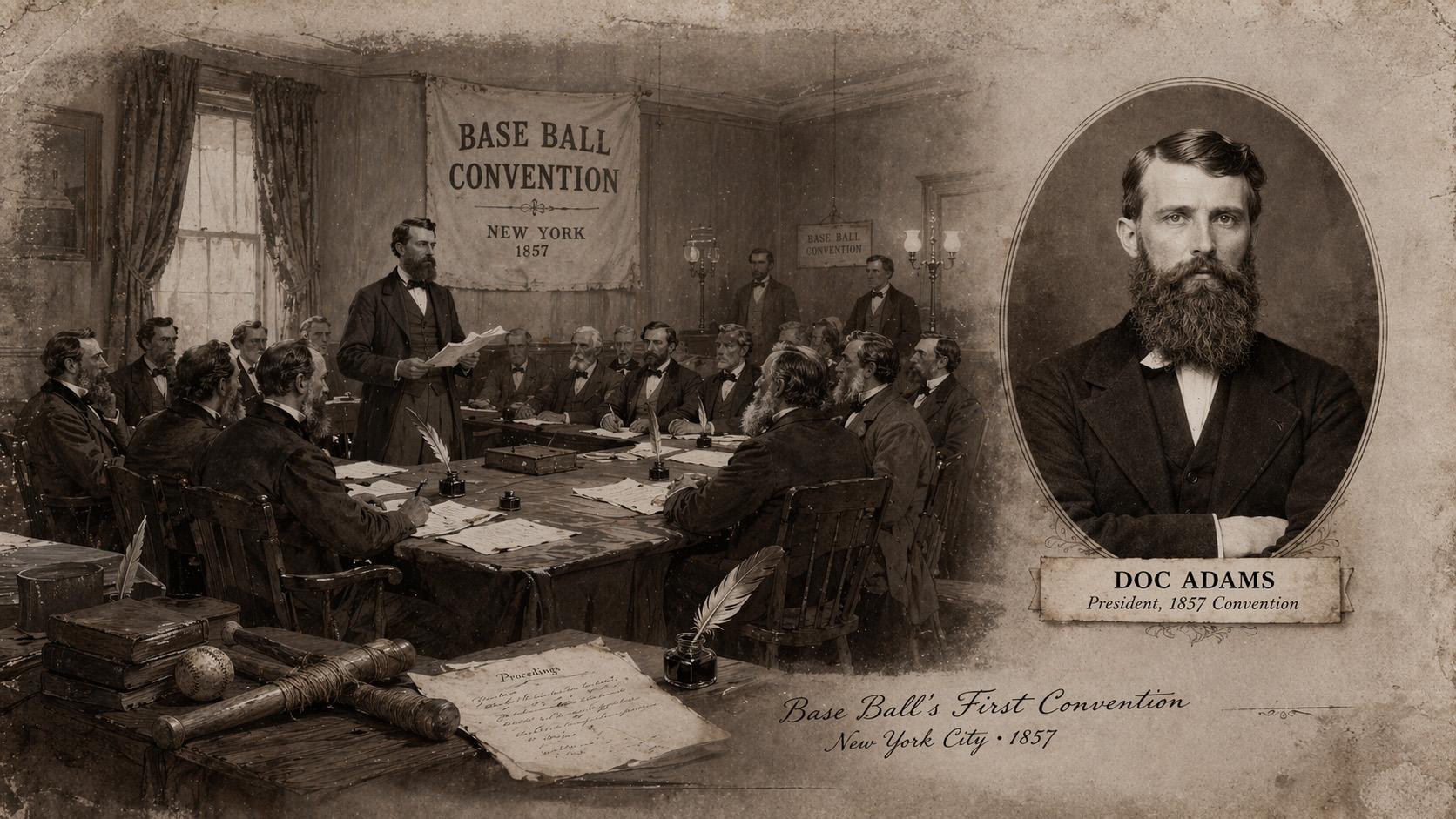
With the ‘Rules of Base Ball’ set to debut at the Hall of Fame, attention turns to the groundbreaking “Laws of Base Ball” and the pivotal inflection point of the 1857 convention — central to Doc Adams’ Hall of Fame case.
Why do rules change?
In most cases, rule changes are not arbitrary — they respond to specific needs within the game. Typically, they are introduced to:
- Clarify ambiguity or improve consistency
- Close loopholes that are being exploited
- Adapt to changes in equipment or playing conditions
- Improve pace of play, balance, and overall action
Understanding why rules change helps us better understand how baseball itself evolved.
Nine Players Per Side
Recent research suggests nine players per side had already become common by the mid-1850s; therefore, the 1857 rule can be seen as a formal codification of an emerging standard.
However, that standard did not appear out of nowhere. It evolved from earlier frameworks, including the original Knickerbocker rules. As discussed in “Analysis of the Laws of Base Ball” in Base Ball, Vol. 9: A Journal of the Early Game, the transition reflects a gradual refinement of how the game was organized and played.
90-Foot Basepaths
The question of basepath distance is more complex.
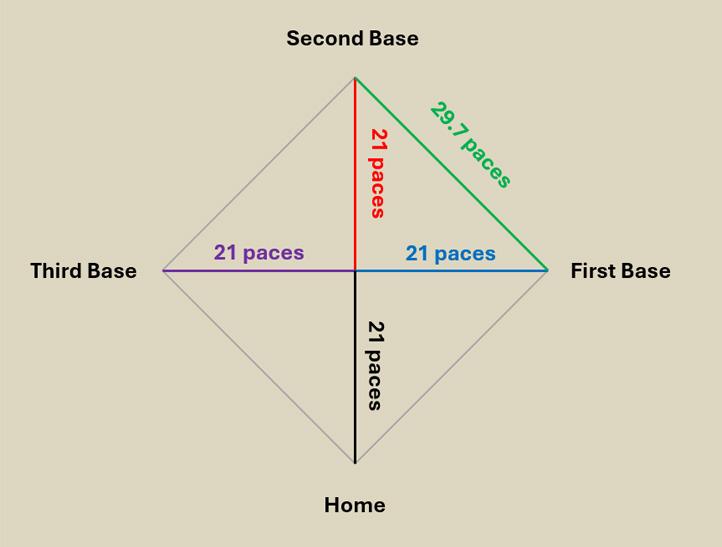
A measurement of 42 paces “from home to second” and “first to third” suggests basepaths of roughly 30 paces. How this converts into standardized distances—and the magnitude of the change it represents — has been interpreted differently by historians.
Interpreting “Paces” and the Move to Measured Distance
The 1828 edition of Webster’s Dictionary defines a “pace” as “estimated at two feet and a half.” By that measure, 30 paces would equal approximately 75 feet (often cited as roughly 74¼ feet depending on interpretation and rounding).
However, the issue is not simply conversion — it is precision.
In the Sporting News interview, Doc Adams recalled:
“The distance between bases I fixed at 30 yards — the only previous determination of distance being ‘the bases shall be from home to second base 42 paces; from first to third base 42 paces equidistant’ — which was rather vague.”
That assessment is critical. The original rule lacked specificity. “Paces” were inherently imprecise — varying by individual and circumstance — and introduced inconsistency from field to field. Such ambiguity left room for uneven play and potential gamesmanship.
Whether early basepaths measured roughly 74–75 feet or fluctuated more broadly in practice, the key point remains:
The 1857 convention replaced approximation with definition.
By establishing 90-foot basepaths, the game adopted a clear, uniform standard — one that eliminated uncertainty and created consistency across all play.
Nine Innings: A Structural Shift
The transition from games decided by “21 aces” (runs) to a fixed nine-inning structure represented a fundamental change in how baseball was played.
Rather than games ending unpredictably based on scoring totals, nine innings introduced:
- A consistent framework for competition
- A more balanced contest between offense and defense
- A clearer, more reliable path to a decisive outcome
This was not a minor adjustment — it was a structural innovation that helped transform baseball into a more organized and spectator-friendly sport.
Context Matters
Taken together, these changes reflect a broader shift:
From informal, flexible play…
to a standardized, rule-based game.
And at the center of that transition was Doc Adams — helping move baseball from approximation to precision, and from pastime to sport.
All of this suggests that we shouldn’t become overly fixated on any single rule in isolation. Much of that focus likely stems from the National Baseball Hall of Fame and Museum defining the “modern game” through the familiar framework — nine innings, nine players, and 90-foot basepaths — long associated with Alexander Cartwright’s plaque.
At the same time, there is broad historical consensus that the 1857 Base Ball Convention marked a true turning point — the moment when baseball began to take the form we recognize today.
But Adams’ story is about more than just rules.
It’s about leadership.
Doc Adams was a pioneer both on and off the field during baseball’s formative years. He is widely credited with creating the shortstop position, shaping not just how the game was governed, but how it was played.
His commitment to the game helped sustain the influential Knickerbocker Base Ball Club at a time when participation was inconsistent and enthusiasm was far from guaranteed. When the Knickerbockers experienced difficulty obtaining balls, Adams stepped in — personally making the them not only for his own club, but for other clubs as well. He even oversaw the production of bats. These aren’t anecdotes — they are documented facts.
His leadership was consistently recognized by his peers. He was elected Knickerbocker team president six times and vice president once, while serving in other leadership roles throughout his tenure. In 1857, he was chosen to preside over the first baseball convention — an event widely regarded as the birth of the modern game. He also served as chairman of the Rules and Regulations Committee of the National Association of Base Ball Players from its founding until his retirement.
When Adams stepped away from the game, the Knickerbocker Base Ball Club honored him as the “Nestor of Ball Players” — a term denoting a patriarch and respected leader in a field.
Contemporary accounts reinforce that reputation. Adams was described as a “Father of Baseball” in publications ranging from the Argus and Patriot to the Chicago Chronicle to The Sporting News.
The record is clear.
His contributions are well documented.
His contemporaries held him in the highest regard.
He has been overlooked long enough.
It is time for the Hall of Fame to fully acknowledge his place in the history of the game.
Discover more from Doc Adams Base Ball (Official)
Subscribe to get the latest posts sent to your email.