
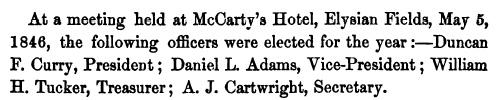
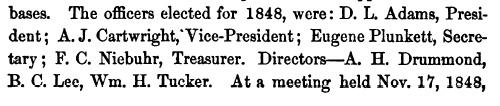
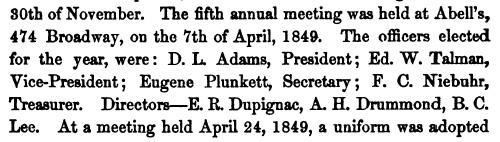
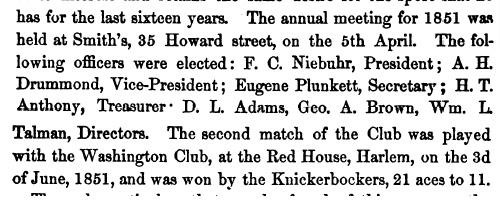
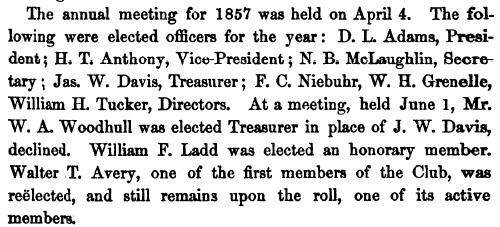
In May of 1846, his first full year with the Knickerbockers, Doc was elected Vice-President of the club and would, over his seventeen years of membership, go on to serve six terms as President (’47, ’48, ’49, ’56, ’57 and ’61) and several terms as a Director. In 1848, Doc headed the Knickerbocker committee to revise the original rules and regulations from the 1845 formation of the club. And in 1853 with the formation of the Gothams (1850) and the Eagle Base Ball Club (1853), Doc was appointed (along with two other teammates) to be part of the committee at a meeting, requested by the Eagle Club, to standardize the rules of play: “the playing rules remained very crude up to this time…”¹
The outcome of this convention was voted on and approved by the Knickerbockers at their annual meeting in April 1854.
The by-laws of 1854 were almost exactly in the same form as those of 1848. There are the following additions to the rules: The position of the pitches was fixed at not less than 15 paces from home base. The forcing of men on bases by a hit is covered, also the put out by touching the base to which the runner is forced, “in the same manner as when running to first base.” The size and weight limits of the ball were first stated as follows: “The ball shall weigh from 5 ¼ to 6 ounces, and be from 2 ¾ to 3 ¼ inches in diameter.”²
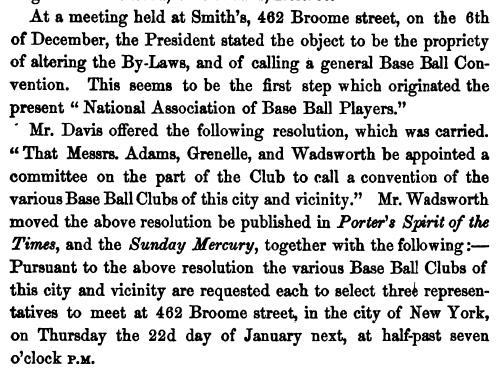
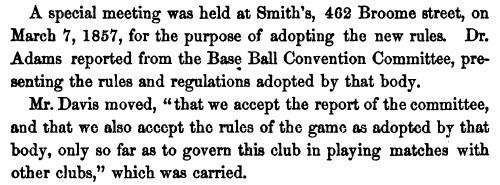
By the end of 1856, there were twelve teams in New York and Brooklyn and in December, at a special Knickerbocker meeting, the Club (Doc was President) resolved to call for a convention of these teams for the purpose of standardizing rules and play. Again, by resolution, Doc and two other teammates were appointed to form a committee and call for a thirteen team convention.
This convention was held in May 1857 and Doc was elected presiding officer. One of the significant resolutions passed at this convention was nine players per side of play and nine innings of play: the team ahead at the end was the winner, and no longer 21 aces/runs.
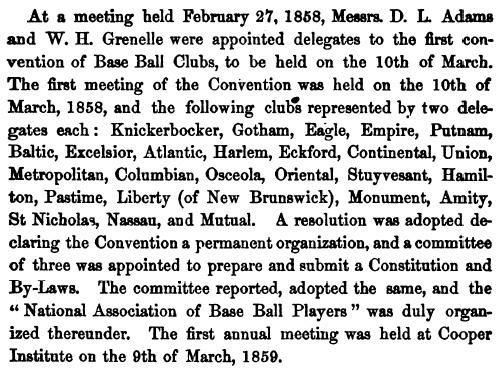
“In March of the next year the second convention was held [at the request of the Empire Club] and at this meeting the annual convention was declared a permanent organization, and with the requisite constitution and by-laws become the National Association of Base Ball Players.”¹
“I was chairman of the Committee on Rules and Regulations from the start and so long as I retained membership [1862]. I presented the first draft of rules prepared after much careful study of the matter, and it was in the main adopted. The distance between bases I fixed at 30 yards—the only previous determination of distance being ‘the bases shall be from home to second base 42 paces; from first to third base 42 paces equidistant’—which was rather vague. In every meeting of the National Association while I was a member I advocated the ‘fly game’—that is, not to allow first-bound catches—but I was always defeated on the vote. The change was made, however, soon after I left, as I predicted in my last speech on the subject before the convention.”
“The distance from home to pitcher’s base I made 45 feet. Many of the old rules, such as those defining a foul, remain substantially the same to-day [1896], while others have changed and, of course, many new ones added. I resigned in 1862, but not before thousands were present to witness matches, and any number of outside players standing ready to take a hand on regular playing days. But we pioneers never expected the game so universal as it has now become [1896].¹”
¹ Dr. D. L. Adams Memoirs of the Father of Base Ball – The Sporting News; February 29, 1896.
² Nestor of Ball Players by R. C. Adams [Doc Adams’ youngest child, 1874-1962]; Buffalo, New York; August 1939. (unpublished).
Baseball’s Pioneers: The History Of The Knickerbocker Baseball Club, 1845-1866 by Charles Peverelly. Originally published in: Book of American Pastimes;1866.
The seminal interview of Daniel Lucius Adams, M.D. appeared in The Sporting News on February 29, 1896. This is the only known first-hand account of Doc’s memories of the game. Similar interviews (or excerpts) began to appear in newspapers across the Midwest apparently originating in The Chicago Chronicle on June 23, 1895.
The Book of American Pastimes Containing a History of the Principal Base Ball, Cricket, Rowing, and Yachting Clubs of the United States is a very significant early baseball book, self-published in 1866 by Charles A. Peverelly. The author devotes 183 of the 556 pages to the emerging sport of baseball, which he refers to as “The National Game.” He also provides histories and match results for many of the most prominent teams in the country at the time, including the Knickerbockers, the Atlantics, the Excelsiors, the Eckfords, the Gothams, and the Mutuals. Long considered the definitive history of baseball’s early years, this book remains a cornerstone of any substantial baseball library. With good reason, it is universally recognized as one of the most important volumes covering the earliest days of organized baseball and is of special note for its recording of so much information that is found nowhere else.
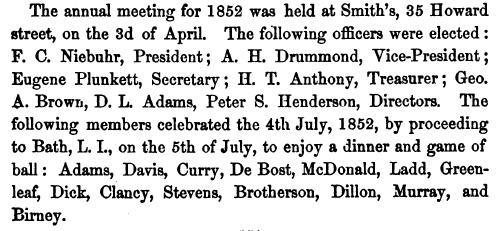
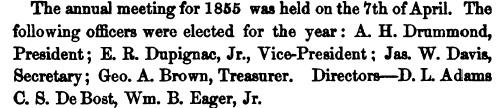
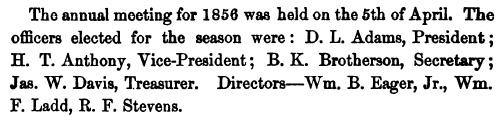
Below are extracts that document Doc Adams’ roles with the Knickerbocker Base Ball Club and the fledgling National Association of Base Ball Players.






He never talked about baseball. We have not one thing in the family, that Doc ever wrote about his time in baseball.
Marjorie Adams, Baseball and BBQ Episode #87: Marjorie Adams
Although there was not a single “Father of Baseball”, Doc Adams was clearly “A Father of Baseball” and these recollections provide some insight into Our National Pastime’s nascent period and an overlooked baseball pioneer.
For his role in making baseball the success it is, Doc Adams may be counted as first among the Fathers of Baseball.
Doc Adams’ SABR Biography, John Thorn, the Official Historian of Major League Baseball